
Replacing James Tavernier: A Data-Driven Shortlist
As much as many love to hate him, James Tavernier has been an integral part of the Rangers squad for over a decade. Replacing him will be easy but fully replacing his output, not so much. Andrew looks at the numbers to determine who could be a suitable replacement.
SCOUTING REPORTS
Andrew
1/15/20268 min read
As we enter 2026, it’s hard to believe that James Tavernier remains Rangers’ most reliable starting right back. Even his most ardent defenders have been saying that we can no longer depend on the Bradford-born club captain to play twice a week in the four competitions Rangers take part in. For me, Tavernier is nothing short of a Rangers legend, but 11 years, 550 appearances and 284 goal contributions after joining from Wigan Athletic for £200,000, it’s clear his time at the top of the Scottish game is coming to an end.
Loanee Max Aarons has flattered to deceive over the course of his time at Ibrox and Dujon Sterling has failed to stay fit enough to have a consistent run of games at any point in his Rangers career. With this in mind, it is essential that in either this January window or the coming summer window, a long-term replacement for James Tavernier is identified and brought in.
Profiling a Rangers right back
The challenge in replacing Tavernier isn’t simply finding another competent defender; it’s replacing a system. For the best part of a decade, Rangers’ right-back has effectively doubled as a playmaker, wide forward and set-piece specialist rolled into one. The role demands far more than overlapping runs and tidy clearances.
Whoever follows Tavernier must be comfortable carrying the ball high up the pitch, delivering consistent final-third quality, and contributing directly to goals through crosses, cutbacks or late penalty-box arrivals. At the same time, Danny Röhl’s preference for aggressive pressing and quick transitions places a premium on recovery pace and the ability to defend large spaces one-on-one. In short, the profile is not “a young right-back”, but a high-output attacking full-back who can live with the physical and psychological demands of Ibrox.
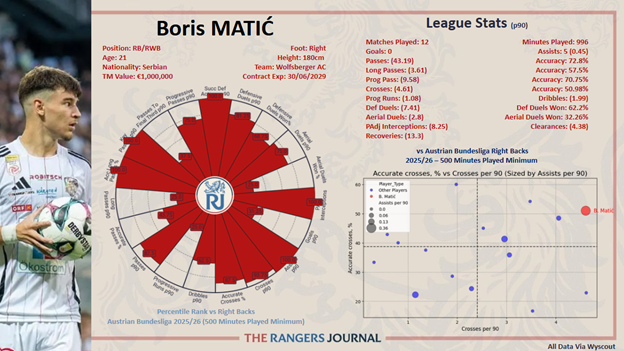
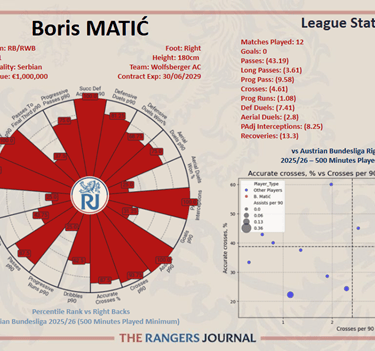
The first name on my shortlist, and my highest priority if I were Director of Football at Rangers, is Boris Matic of Wolfsberger AC in the Austrian Bundesliga. The Serbia U21 international joined Wolfsberger from Red Star Belgrade in January 2024 and has since established himself as one of the top full backs in Austria. As displayed on the chart in the graphic above, Matic leads the Austrian Bundesliga in assists per 90 minutes played, successful defensive actions per 90 minutes played, key passes per 90 minutes, long pass accuracy and possession adjusted interceptions.
His creative ability is further highlighted by the graph on the bottom right of the graphic, where Austrian Bundesliga right backs’ crosses per 90 minutes are compared with their cross accuracy %. Matic’s position in the top right corner of the graph demonstrates that he delivers a very high volume of crosses without sacrificing accuracy. Furthermore, the size of each circle on the graph displays each player’s assists per 90 minutes, indicating that Matic’s crossing consistently results in goals for his team.
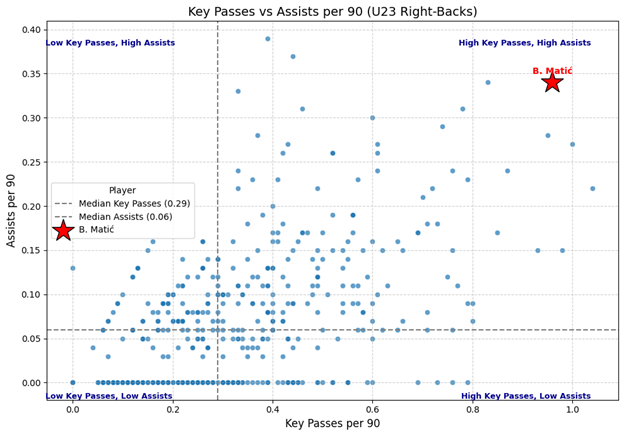
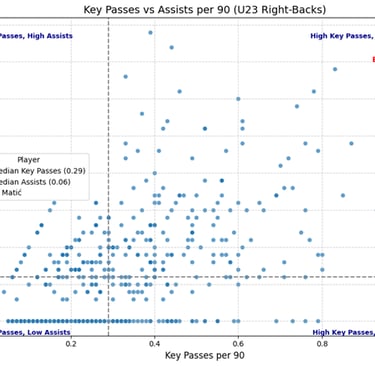
The graph above demonstrates Matic’s ability to fill the creative gap that is left by James Tavernier. While he is not a goal scorer, the his placement in the far right of the plot demonstrates that his key passes per 90 numbers are among the best of U23 right backs outwith the top 5 leagues, while his position near the top indicates that these key passes regularly result in goals - more than all but 4 of the right backs in the data.
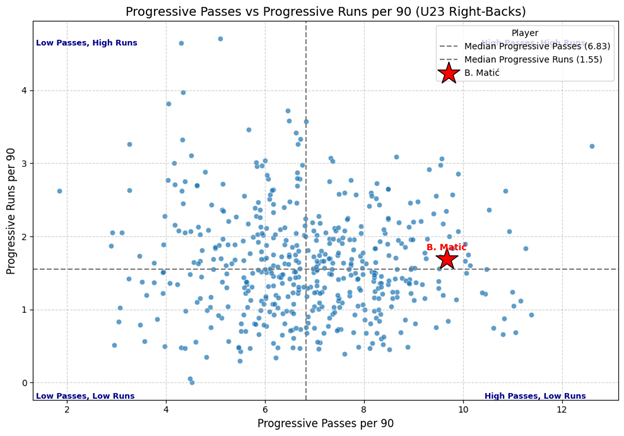
Matic’s involvement in build-up is based more on progressive passes rather than runs, however his position in the top right quadrant of the chart above does show that among U23 right backs with over 500 minutes played in the 2025/26 season (or 1000 minutes for those playing in leagues with calendar year seasons) he makes both more progressive passes and progressive runs than his peers, showing he is adaptable to whatever requirements or instructions his manager gives him.
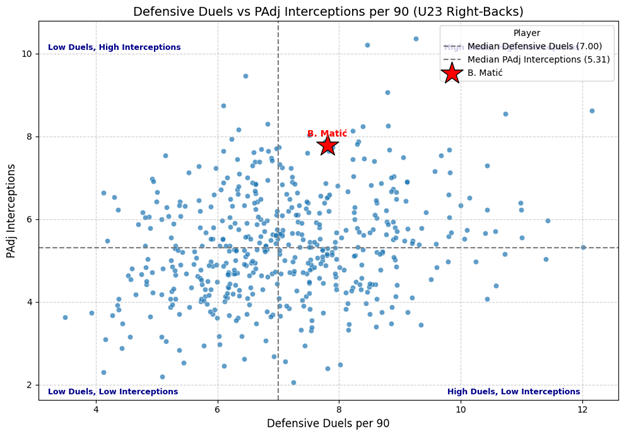
While, like Tavernier, Matic’s main strengths are as an attacking full back, his underlying defensive numbers indicate a strong defensive base - allaying the concerns of our Rangers da readers! His position in the top right quadrant of the graph below indicates that he is both a positionality intelligent and high-intensity pressing defender, scoring highly among his peers both in possession adjusted interceptions and defensive duels per 90 minutes.
Denzel de Roeve, Brann
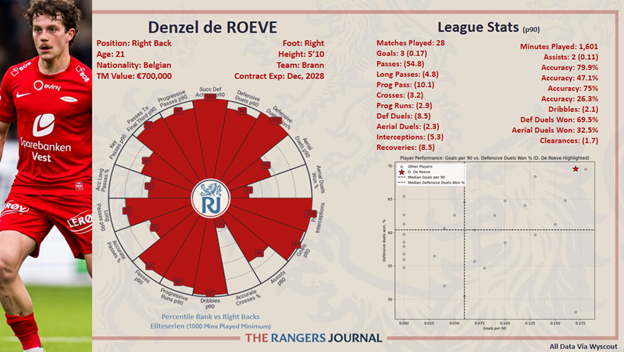
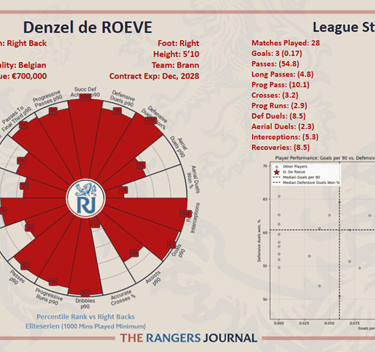
Denzel de Roeve is a young Belgian right back who Rangers supporters may remember from our recent disappointment away at the Norwegian club in the Europa League. The Belgian U21 international joined Brann from the well-respected Club Brugge academy at the beginning of the 2025 Eliteserien season for a fee of €400,000 and quickly established himself as one of the top full backs in Norway.
De Roeve led the 2025 Eliteserien in the majority of key defensive metrics, including successful defensive actions per 90, defensive duels won % and possession adjusted interceptions. His underlying attacking numbers are also among the division’s elite, placing in the top 5% for key metrics such as goals per 90 and dribbles per 90, while placing in the top 10% for progressive passes per 90, progressive runs per 90 and passes to final third per 90. His placement in the top right quadrant of the graph on the bottom left of the graphic excellently demonstrates his effectiveness at both ends of the pitch, scoring as the second best in the league when comparing goals scored per 90 minutes with percentage of defensive duels won.
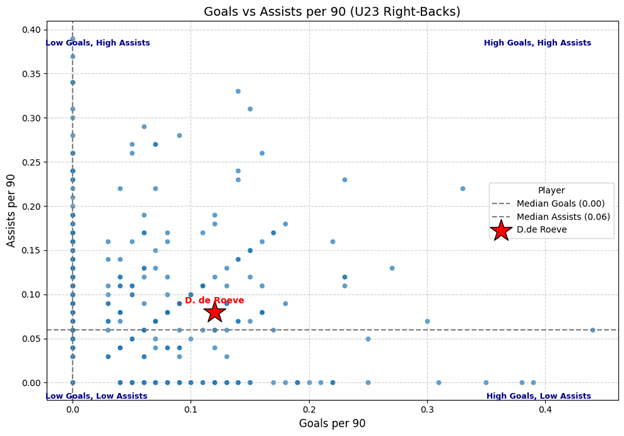
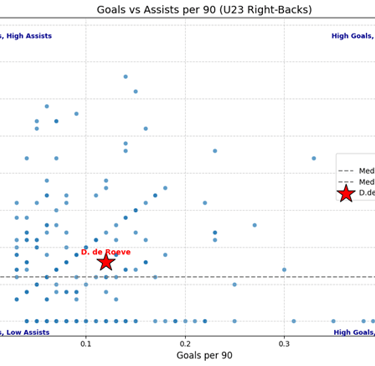
Over the course of his time at Rangers, James Tavernier has been a key attacking threat for the club. While his goalscoring record is something of an anomaly for a full back and therefore will be near-impossible to replicate, this is an area we would like any incoming right back to be able to contribute in. The graph above indicates that, while not an extreme case, de Roeve does place in the high goals and high assists quadrant. This means that he will be able to provide a dual attacking threat, both through setting up his teammates and scoring goals himself.
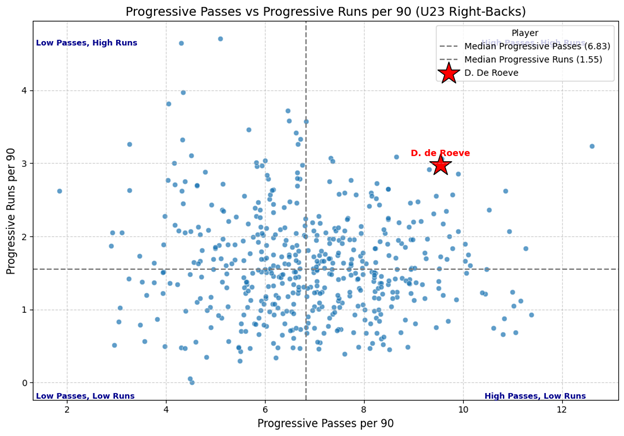
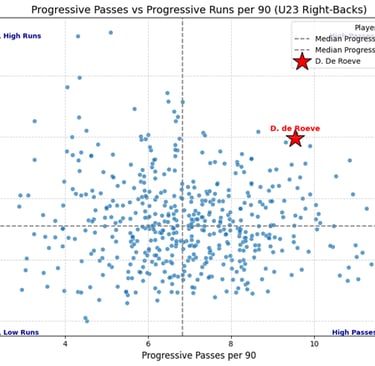
The versatility of his attacking threat is also demonstrated through a ball progression scatterplot, comparing progressive passes per 90 minutes with progressive carries per 90 minutes. Placing further to the right of the chart demonstrates that a player often advances the ball for his team through passing, while placing towards the top of the chart displays he often advances the ball through running with it himself. As we see on the chart below, de Roeve places in the top right quadrant indicating he provides value to his team through both. In fact, his position in the top right corner of the pack demonstrates that he is elite in both areas among U23 right backs outside the top 5 leagues. This level of tactical and technical flexibility would provide an invaluable weapon for Danny Rohl.
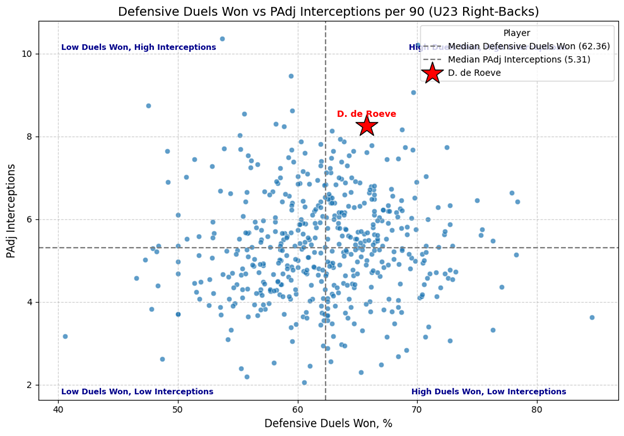
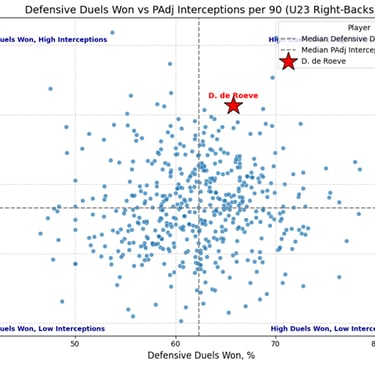
Conversely from Tavernier, the young Belgian really shines defensively. In the Norwegian Eliteserien, he tops the league in percentage of defensive duels won, successful defensive actions per 90 minutes and possession adjusted interceptions among right backs. He equally shines in these metrics when compared to our global database of U23 right backs, as displayed in the defensive duels win percentage vs possession adjusted interceptions scatterplot below. Once more, de Roeve places in the top right quadrant, scoring better on both metrics than the vast majority of U23 right backs. He is closer to the top than the right of the chart, indicating he is slightly stronger in duels than with positioning for interceptions, however he is clearly elite in both metrics.
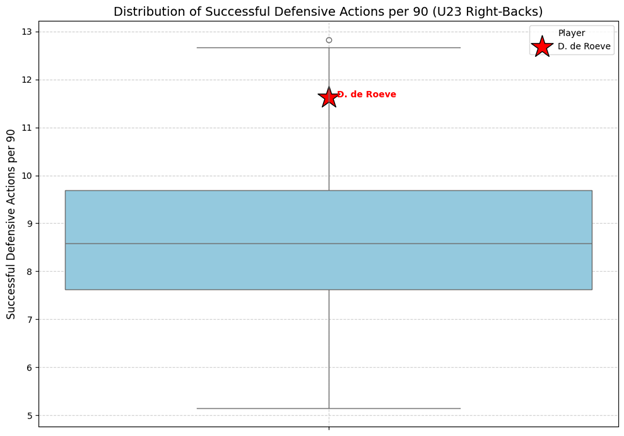
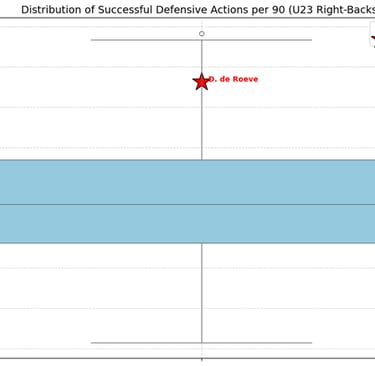
His defensive competence is further underlined by the boxplot representing the distribution of successful defensive actions per 90 in our U23 right back database. With 11.63 successful defensive actions per 90, he is towards the top of the upper quartile indicating elite defensive contribution for his team.
Femi Seriki, Sheffield United
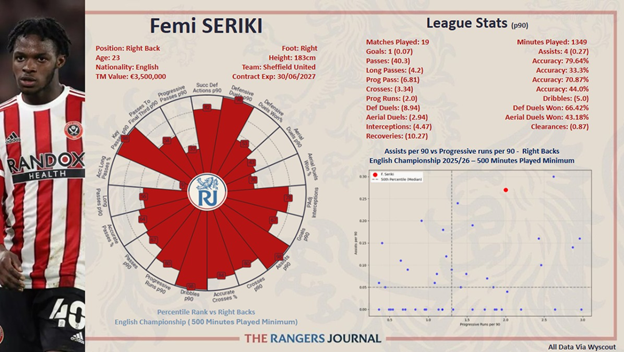
Femi Seriki is a 23-year-old right back, born in Manchester and a product of both the Bury and Sheffield United academies. Since crossing the Pennines in 2019, Seriki has spent time on loan with Beerschot, Boston United, Rochdale and Rotherham United before establishing himself as a first team player in the 2024/25 season.
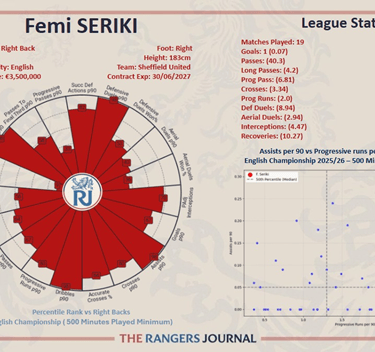
At the time of writing, has more key passes, assists and dribbles per 90 minutes than 98% of right backs in the English Championship, indicating an elite attacking threat at this level. His position in the assists per 90 minutes vs progressive runs per 90 minutes scatterplot on the bottom right of the graphic further displays his attacking threat, highlighting he is one of the most effective ball carriers in the league.
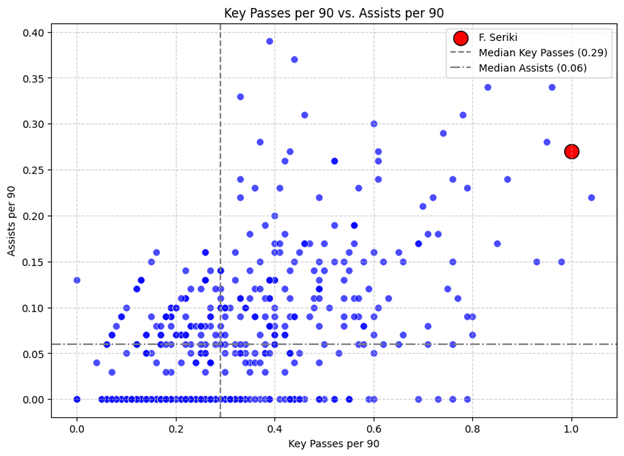
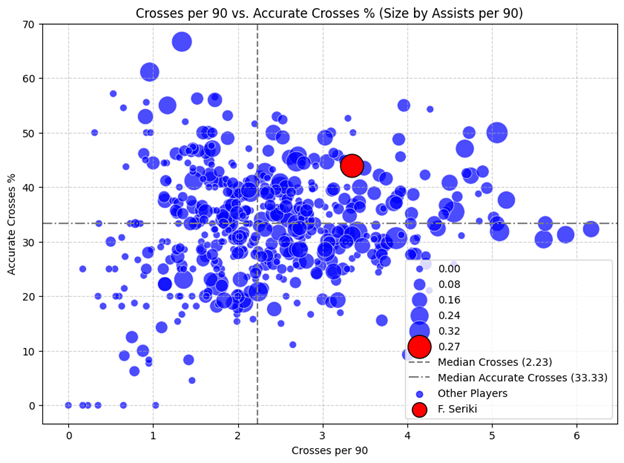
Seriki’s creative effectiveness is highlighted by the key passes per 90 vs assists per 90 scatterplot displayed above. His placement in the extreme top right of the graph demonstrates that not only does he provide an elite number of key passes compared to other U23 right backs outwith the top 5 leagues, a significant amount of those passes actually result in goals for his team. Crossing is another facet of the creative threat that Seriki provides, as underlined by the crosses per 90 vs cross accuracy percentage scatterplot displayed below. Placing once more in the top right of the plot, Seriki is elite among his peers in this area.
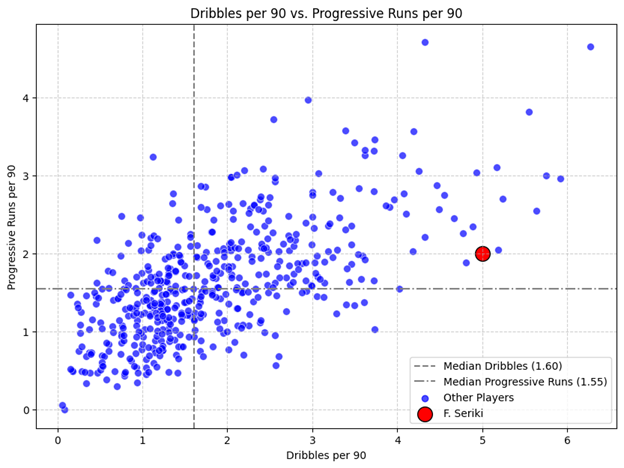
Seriki also provides a threat through carrying the ball forward directly as displayed by the next scatterplot below. His placement in the top right quadrant when comparing dribbles per 90 against progressive carriers per 90 indicates that not only does he like to take on his man regularly, more often than not his dribbles end up with the ball entering the final third. This combination of passing and dribbling threat demonstrated by these three graphs shows that he could provide a versatile attacking threat for Danny Rohl.
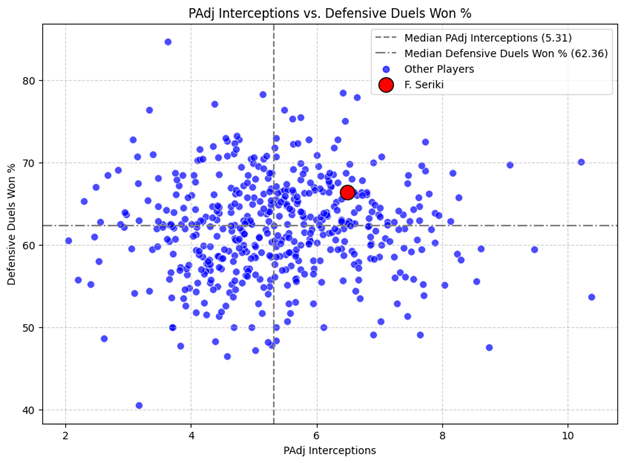
At the other end of the pitch, Seriki profiles as an above-average defensive full-back when compared to his peers. He sits to the right of the median for possession-adjusted interceptions, indicating strong anticipation and an ability to read play rather than relying purely on reactive defending. At the same time, his defensive duels won percentage is also above the positional median, suggesting he is reliable when directly engaged in 1v1 situations. This combination points to a defender who can both step in to disrupt passing lanes and hold his own in physical or ground duels, rather than excelling in just one defensive phase.
The Rangers Journal Podcast
News
Scouting
© 2025. All rights reserved.
Analysis